Articles About: Hip
Hip Arthroscopy for Impingement and Labral Repair
Related to: Hip, Surgical Procedures, Hip Arthroscopy for Impingement & Labral Repair
Recent advances in arthroscopy have been made to allow appropriately trained surgeons to address these same abnormalities, but entirely through the arthroscope. Dr. King treats hip impingement and labral tears through the arthroscope alone. The procedure involves removal of the extra bone on the acetabulum, labral repair with bone anchors and suture, and removal of extra bone on the femoral side. 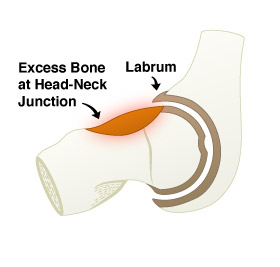 Many surgeons who perform hip arthroscopy choose to remove portions of the labrum that are torn with arthroscopy, followed by an open incision to remove the extra bone on the femoral side of the hip joint. It is Dr. King’s belief, and that of others, that preserving and stabilizing the labrum is very important for the health of the hip joint. Removal of portions of the labrum has been shown to improve patient’s symptoms for a short period of time, but that improvement begins to deteriorate with time. Those who have undergone labral repair have lasting improvement in their symptoms.
Hip Labral Tears
Related to: Hip, Common Diagnoses, Hip Impingement, Labral Tear
Labral tears in the hip are a common source of hip pain. These tears are most frequently seen in the setting of hip impingement, but can occur from a single traumatic event. Tears often cause groin, hip or buttock pain. They can also result in catching, clicking or locking when the hip is moving. The best method to diagnose labral tears is a MRI with contrast injected into the hip, also known as a MRI arthrogram. Symptomatic labral tears can be treated with hip arthroscopy and labral repair.
Continue Reading »Hip Anatomy
Related to: Hip, Common Diagnoses, Hip Anatomy
The femoral head is attached to the lower femur by the femoral neck. The transition between the head and neck is often referred to as the head-neck junction. It is important to have a femoral head that is round and much larger than the femoral neck supporting it. This difference in size (diameter) is called the head-neck ratio. The larger the ratio, or difference between the head and neck, the more motion available to the hip before the bone at the head-neck junction contacts the bone at the rim, or edge, of the acetabulum. If excess bone develops at the head-neck junction, the ratio between the head and neck is decreased and contact between the ball and socket occurs much earlier in motion. This early contact is often referred to as hip impingement. Early contact can also occur due to increased bone at the edge of the socket, a deep socket or a poorly positioned socket.
Continue Reading »Hip Impingement
Related to: Hip, Common Diagnoses, Hip Impingement
Hip impingement, also known as femoroacetabular impingement (FAI), is a condition involving abnormal bony anatomy in the hip.  Specific events or repetitive hip motion, in combination with these bony abnormalities, often lead to labral tears and cartilage damage. The most common complaint is groin, hip or buttock pain when the hip is bent. The bony impingement and subsequent soft tissue injuries are believed to be the initial events that lead to hip arthritis in younger patients.
Hip Arthoscopy - Overview
Related to: Hip, Surgical Procedures, Hip Arthroscopy- Overview
Hip arthroscopy uses minimally invasive techniques to address a variety of hip problems in the young, active individual. Special instruments and cameras (Image 1) are passed through small incisions in the skin surrounding the hip. Techniques have been developed using these particular instruments to correct injuries previously treated with large open incisions and surgical hip dislocation.
Continue Reading »Birmingham Hip Resurfacing
Related to: Hip, Surgical Procedures, Birmingham Hip Resurfacing
 Birmingham Hip Resurfacing is a procedure to treat hip arthritis in young, active patients. Although traditional total hip replacement (THA) is an extremely effective procedure, questions remain about its longevity.
Continue Reading »
Hip MRI & X-Ray Review
Related to: Hip, MRI & X-Ray Review
We are currently offering to review your X-rays and/or MRI scans to determine if an office visit would be appropriate to discuss any of the following: hip impingement, hip arthroscopy, labral repair, hip resurfacing or total hip arthroplasty.
Continue Reading »Hip Osteoarthritis
Related to: Animations, Hip, Common Diagnoses, Hip Arthritis
Osteoarthritis of the hip is a condition that develops as a result of the loss of the normal hip cartilage. The cartilage is the smooth tissue on the end of bones that allows the hip to glide smoothly and painlessly. Over time, this cartilage can wear away resulting in bone rubbing on bone. This is generally a painful condition and can be a source of significant discomfort at night. Joint replacement is the definitive surgical choice to correct hip arthritis. Possible surgical options include: Birmingham Hip Resurfacing (BHR), large head metal-on-metal total hip replacement or traditional total hip replacement.
Continue Reading »Muscle Sprains
Related to: Hip, Common Diagnoses, Muscle Sprains
Numerous muscles originate, insert and/or pass through the hip region. Specific muscle injuries lead to pain in the corresponding areas of the hip. Treatment is dependent on the muscle injured and amount of damage that has occurred.
Continue Reading »Snapping Hip Syndrome
Related to: Hip, Common Diagnoses, Snapping Hip Syndrome, Surgical Procedures, Arthroscopic Snapping Hip Release
Painful snapping in the hip can be caused by tendons rubbing over bony prominences in the front or outside of the hip. The main treatment for this condition is physical therapy combined with medications or injections. Occasionally these treatments will be ineffective, and an arthroscopic snapping hip release may be performed to alleviate the symptoms.
Continue Reading »Resources
Disclaimer: The articles and resources provided are based on scientific articles and Dr. King’s medical opinion. Continue Reading »
Contact
- Location:
- 1050 Old Des Peres Road
- Suite 100
- Saint Louis, MO 63131
- Phone:
- (314) 569-0612