Hip Impingement
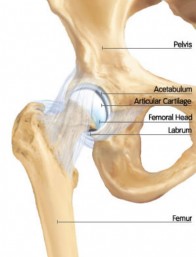 Hip impingement, also known as femoroacetabular impingement (FAI), is a condition involving abnormal bony anatomy in the hip. The abnormalities can be seen on the femoral side of the joint (Cam lesion) or on the acetabular side (Pincer lesion). Hip impingement, also known as femoroacetabular impingement (FAI), is a condition involving abnormal bony anatomy in the hip. The abnormalities can be seen on the femoral side of the joint (Cam lesion) or on the acetabular side (Pincer lesion).
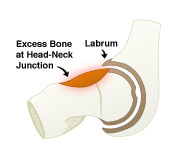
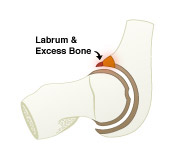
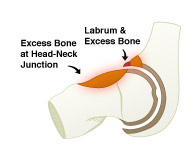
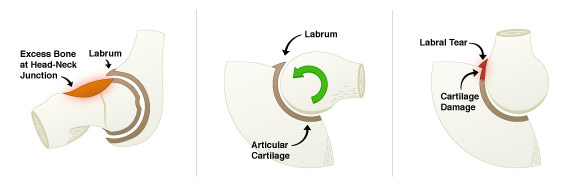
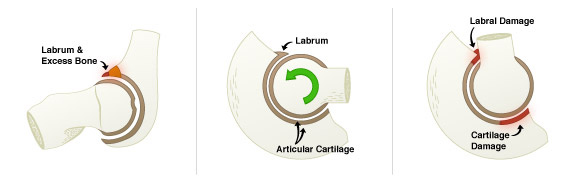
These abnormalities likely occur during development, however, they are often not recognized until later in life. The general finding is excess bone in the areas shown in the associated figures (Figures 1 & 2). Although isolated impingement is seen, the most frequent finding is a combination of Cam and Pincer impingement (Figure 3). Specific events or repetitive hip motion, in the setting of these bony abnormalities, often cause soft tissue injuries in the hip joint. The most common injuries are to the hip labrum and joint cartilage (Figures 4 & 5). Activities that cause problems with hip impingement are those that involve hip flexion, such as: sitting in a car, squatting, and bending during various athletic exercises. Patients suffering from hip impingement complain of pain is the groin, but discomfort can be in the buttock or outside aspect of the hip. Increased stiffness with decreased motion in the hip is also a typical complaint from patients with this condition.
See hip impingement animation
To see animation, click the link above. Enter the animation window. Click hip, then condition and the hip impingement tab
Figure 1
CAM impingement |
Figure 2
Pincer impingement |
Figure 3
Mixed impingement |
 |
 |
 |
| Figure 4 – Cam impingement injury patterns |
 |
| Figure 5 - Pincer impingement injury patterns |
 |
Video of Patient Hip with Labral Tear:
|
Video of Hip Arthroscopy for Impingement and Labral Repair:
|
|